

There is no doubt that the House of Pleasure (or the so-called Brothel) is one of the spots my guests are most curious about during our tours. The most important reason for them to wonder about the house of pleasure in Ephesus Ancient City is the Ephesus brothel footprint sign carved on marble, which is thought to be an advertisement for the love house.
While popular culture labels this as an “advertisement for the Love House,” as a local expert, I want to share the deeper reality behind these stones.
Table of contents
Reason Behind the Assumption
The main reason why this building is thought to be a house of pleasure is probably the floor mosaics depicting the Dionysus festival. Considering that the Dionysus festival, which is held every year in March, is depicted in many Roman mosaics, it does not seem like a real reason.
🏗️ A Pleasure Complex?
Built during the reign of Emperor Trajan (98-117 AD), this building wasn’t standing alone. It was architecturally connected to the Scholastica Baths and the Roman Latrines. This implies a massive complex designed for bodily needs—cleaning, relieving, and pleasure—all in one city block.

So What’s the Real Deal?
As your guide, let me explain the reality. However, to mention briefly, in this area directly opposite the Celsus library, three private houses were unearthed. The house in the middle of these 3 houses is a two-storey peristyle house that has long been mistakenly interpreted as a pleasure house. The other 2 houses are rich houses of different architecture, and the shops open to Curetes Street. It is not surprising that what is called the house of pleasure is actually the home of the rich. So there are Terrace Houses 1 and Terrace Houses 2, which are called rich houses, right across the street. Well, weren’t there houses of pleasure in the ancient Roman culture? Of course, there were…
🗿 Must-See at the Museum: The Priapus Statue
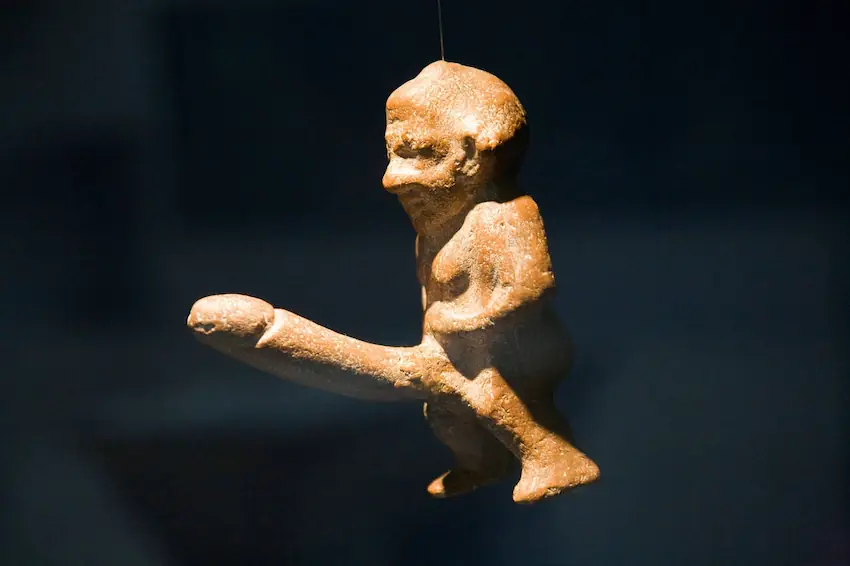
During the excavations of this building, a famous terracotta figurine of Priapus (Bes) was found inside a water well on the premises. Known for his oversized phallus, Priapus was a god of fertility and a protector against the “evil eye.” You can see this intriguing artifact today in the Ephesus Archaeological Museum in Selcuk.
⛔ The “Secret Tunnel” Myth
In my 20 years of guiding, the most common question I get is: “Is there really a secret tunnel from the Celsus Library to the Brothel so men could lie to their wives about reading?”
The answer is NO. Geographically and architecturally, this is impossible because the Library and the so-called Brothel are on different elevation levels and separated by a solid street. The “tunnel” people often mistake for a passageway is actually a massive drainage channel for the city’s sewage system. Trust me, you wouldn’t want to crawl through there.
🐈 The Famous “Cat & Mouse” Mosaic
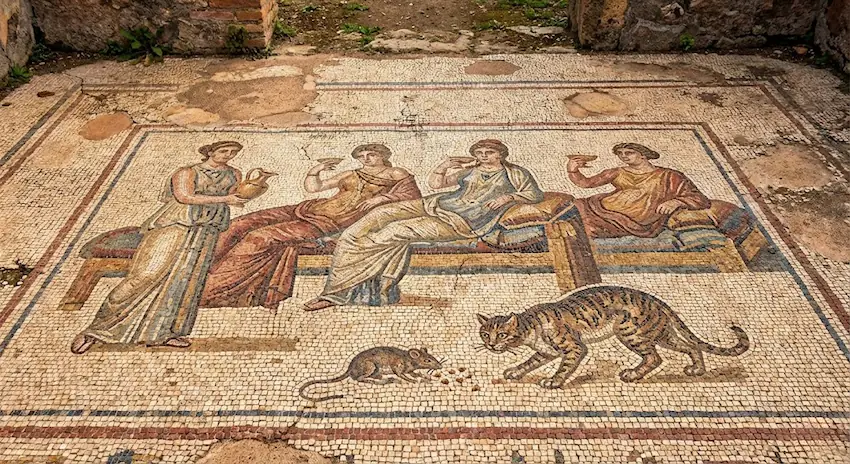
Although you can’t enter the building, as your guide, I can tell you about the masterpiece hidden inside. The dining room (Triclinium) floor is covered with a stunning mosaic depicting the Four Seasons.
But the real charm is in the details: One scene depicts three women drinking wine, a servant standing by, and my favorite part, a mouse eating food crumbs while a cat watches it intently. It’s a vivid snapshot of daily Roman life frozen in stone.
Prostitution in Ancient Rome

Ancient Rome was a fascinating period of history. The Roman Empire was the center of trade. One of the income and most popular trades in Ancient Rome was prostitution, just like many other civilizations. Prostitution in Rome was not regulated by law because it was considered to be an occupation that women could choose freely. In the Roman Empire, many sex workers in antiquity were either slaves or freedwomen with limited job opportunities. Some were women of poor families who had been sold by their parents.
Legal and Social Perception
The Romans tolerated prostitution so long as it did not disturb public order, as they considered prostitution as a beneficial evil in society and did not want to push trade into secret places (such as brothels) where it could cause problems. As we clearly see, it’s not that different from the prostitution of today. Ancient Romans had a very different view of sexuality and the place of prostitution in society. Although prostitution was not illegal, it was associated with the lower classes.
Read also: Marriages in Ancient Ephesus

Brothels and Their Operation
Brothels in the Roman Empire were generally located near theaters or other entertainment venues and often advertised by a lit sign depicting a woman holding one arm across her breasts and another arm pointing down to her genitals. They were typically run by a madam who acted as an agent between the sex workers in antiquity and the customers, just like today, while also providing protection for the workers from those wishing to abuse them.
Frequently Asked Questions
It is popularly interpreted that way (foot pointing direction, heart for love, woman’s head). However, some historians argue it might be a directional marker for a portrait gallery or simply graffiti.
Historical records suggest that services in Ephesus brothels were generally affordable for the average citizen (often the price of a loaf of bread), though high-end courtesans charged fortunes.
The Ephesus brothel can only be seen from the outside.
Hear the Real Stories of Ephesus 🤫
Was it really a brothel or just a rich house? Is the secret tunnel real? Don’t rely on guidebooks. Join my Private Ephesus Tours, and I will show you the hidden details and tell you the stories that stones can’t speak.


No Responses