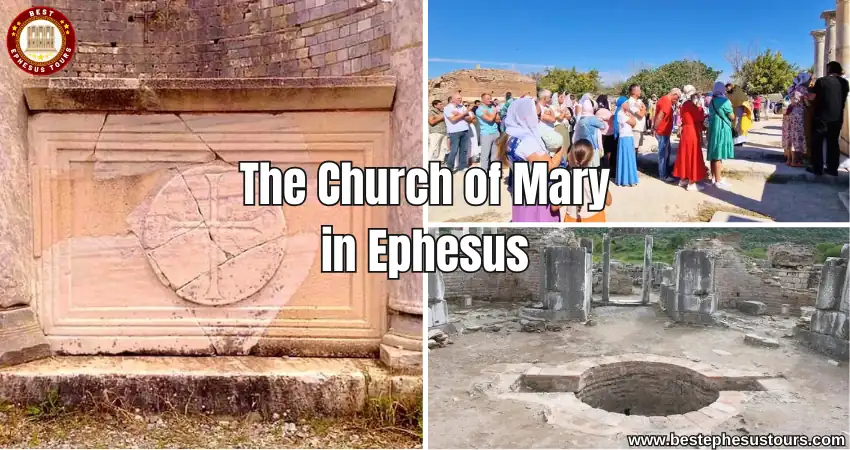
The construction of the church of Ephesus (also known as the Church of Mary) dates back to the 5th century. It is assumed that the church was constructed specifically for the Third Ecumenical Council in 431, above the ruins of an earlier pagan structure that was abandoned in the 3rd century. The Church of Ephesus is also a highlight of our Biblical Ephesus Tour.
📍 Guide’s Note: Church vs. House
Many visitors confuse these two distinct locations. Please note they are completely different sites located 7 km (4.5 miles) apart:
1. The House of the Virgin Mary: Located high up on Mt. Koressos (outside the ancient city). It is a small stone shrine believed to be her final home. (Requires a separate admission fee).
2. The Church of Mary (This Site): Located inside the Ephesus Ancient City near the harbor. It is the massive cathedral ruin where the 3rd Ecumenical Council actually took place in 431 AD. (Included in your main Ephesus ticket). On my Biblical tours, we make sure to visit both!
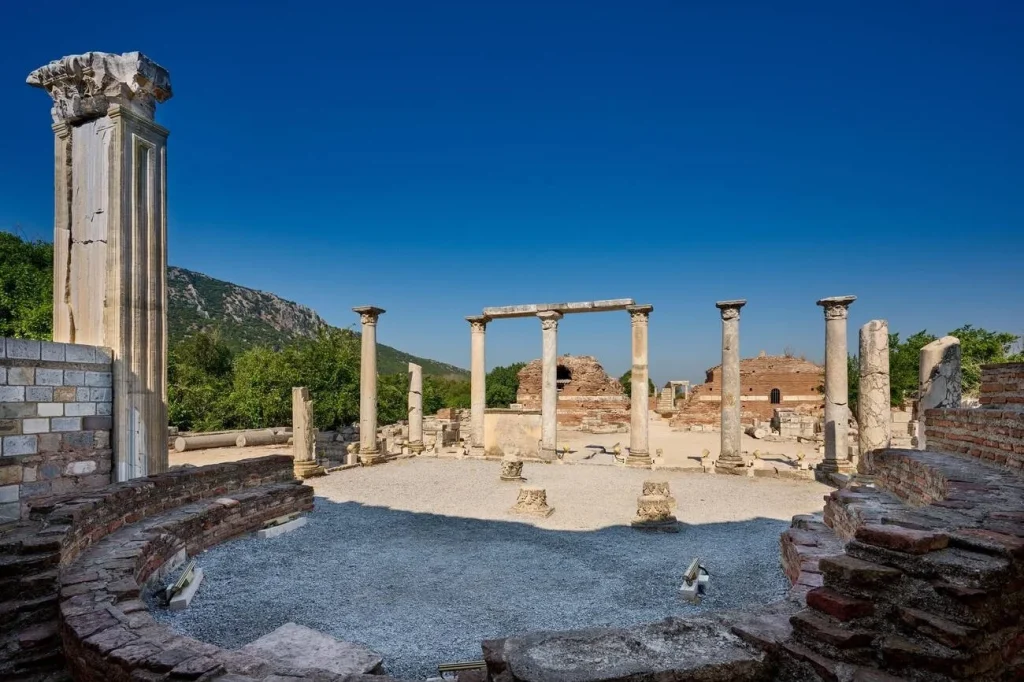
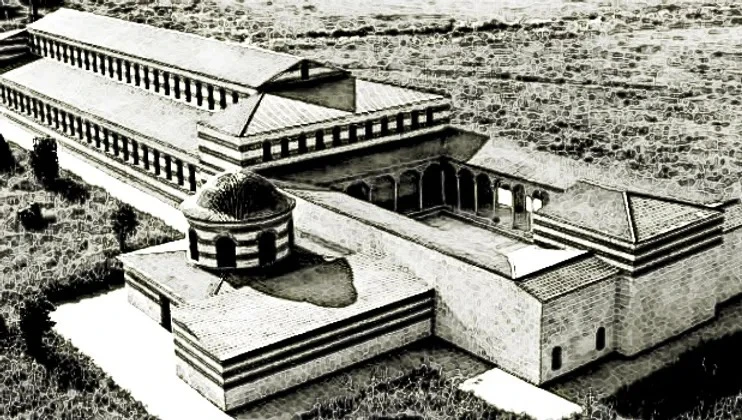
The north side of the construction area was occupied by the Olympeion, built around 130 AD for the Imperial Cult of Hadrian, similar to Zeus in Olympos. The Church of Mary was replaced on the southern side of the porticoes surrounding the temple sanctuary. It was 145 meters long and 30 meters wide. The extra-long dimension of the church building can be explained by being a part of an early pagan structure. In later times, two more churches were built inside this ancient building, arranged one behind the other.
🤫 Insider Tip: The “Hidden” Church
Here is a secret that many standard group tours won’t tell you: Although the Church of Mary is inside the ancient city limits (near the Harbour Bath), it requires a slight detour. Because of this, large rushed groups often skip it entirely, and visitors exit without seeing this historic spot!
📍 How to find it: As you walk towards the Lower Gate (Exit) at the end of your tour, look for the ancient Milestones and Sarcophagi. Immediately to your LEFT, you will see a dirt path leading down through the trees. It’s only a peaceful 5-minute walk, and best of all—entrance is Free (already included in your Ephesus ticket).
The Church at Ephesus was rebuilt several times, so the structure we can see today does not really reflect the actual appearance of the Church of Ephesus from the time of the Ecumenical Council. After the first church fell into ruins, it was replaced by the new basilica, but with smaller dimensions, in the space of the old church. The new church entrance was replaced through the apse of the old one.
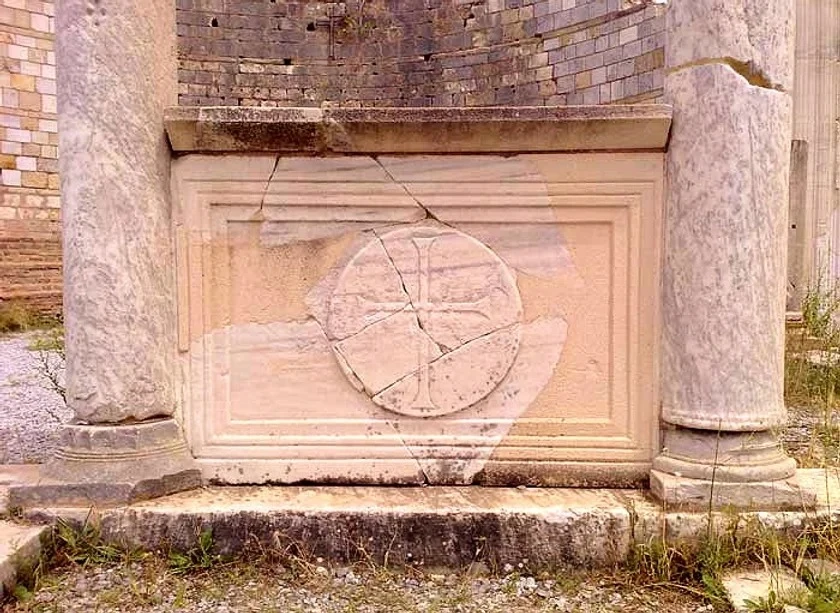
This small new church was reconstructed with two additional rows of columns supporting the roof. Finally, the whole structure collapsed, and the space was mostly used as a cemetery. It is not known when exactly the Church of Ephesus collapsed. But there are the icons of the Virgin Mary from the 12th-century mentions of the “old church”. Thus, it is believed that the church must have survived at least until the end of the 12th century. But is known that the Church of Mary functioned as a cemetery church only, after the seat of the bishop moved to the Basilica of St John in the 7th century AD.
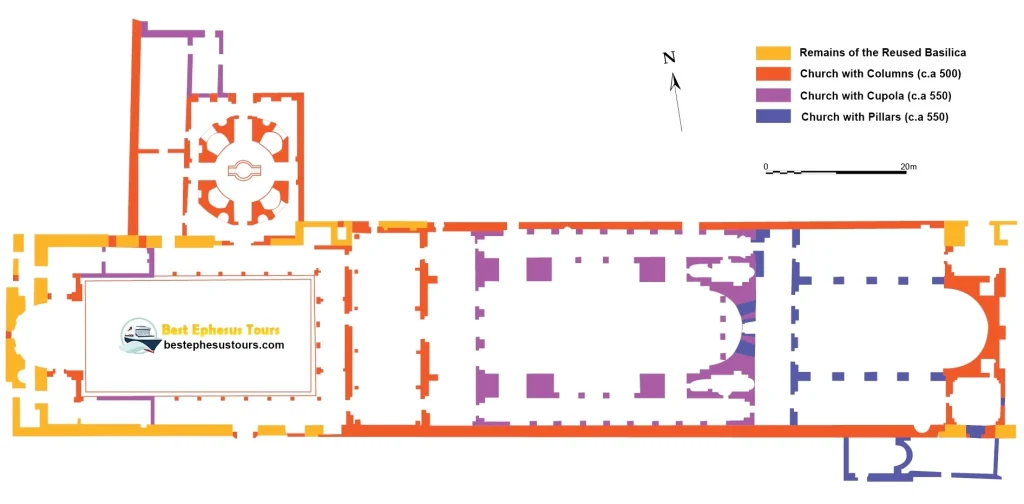
The best-preserved part of the structure is a baptistery, located in the northern part of the atrium. There was a pool, in the central part of this Baptiste, where the baptized people could be fully submerged in water.
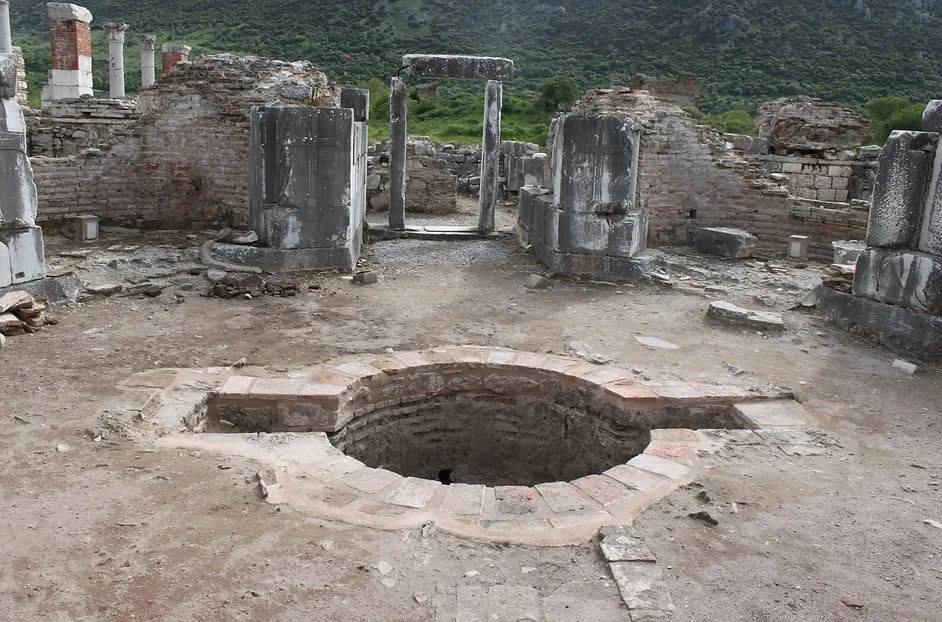
💧 The Ancient Baptistery
When you look at the keyhole-shaped pool in the baptistery, remember that in early Christianity, baptism was mostly for adults and involved full body immersion. The bishop would stand on the side while the initiate walked down the steps into the holy water.
The Third Ecumenical Council
The Council of Ephesus, also known as the third ecumenical council of the great church of Mary, was convened in 431 by Emperor Theodosius II. This was one of the most significant Christian events that took place in the ancient city of Ephesus. More than 250 delegates and archbishops from different Patriarchs, such as Rome, Alexandria, Constantinopolis, and Antioch, arrived at Ephesus. One of the purposes of this council was to settle the dispute on the understanding of the person of Jesus. Accordingly, one of the main subject issues discussed was the concern about Mary’s title.
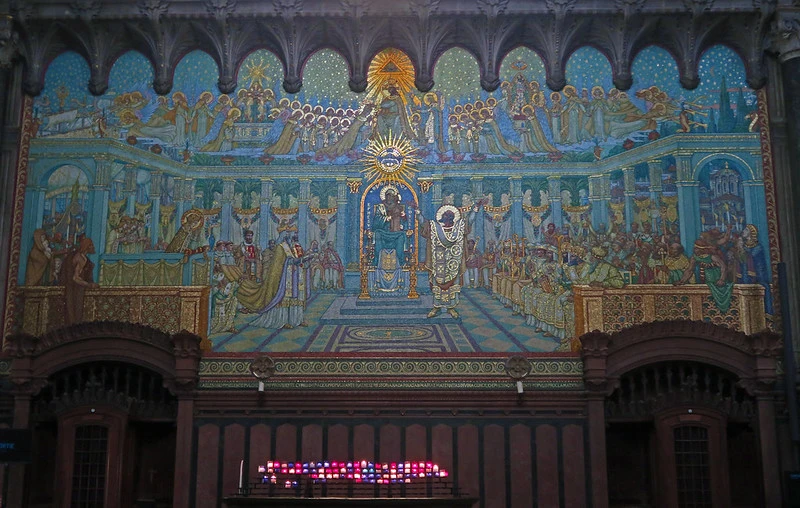
Either the Mother of God or the Mother of Jesus. The Syrian churchman Nestorius emphasized the true humanity of Jesus by insisting that Mary, the Mother of Jesus, gave birth to Christ, not God himself. Thus, he used the term christotokos (Christ-bearer) for Mary rather than Theotokos. Nestorius also emphasized that only Christ, not God, died on the Cross. The Council of Ephesus decreed that Mary is the Theotokos as one divine person from two natures (divine and human) intimately united. In the canons of the third ecumenical council city of Ephesus is described as “where John the Evangelist and the Virgin Mary lived and were buried”. Therefore, Mary has always been strongly linked to Ephesus through the decision of the council.
⚖️ A Clash of Titans: The Story Behind the Council
Why does this Council matter so much? Picture a heated debate that would shape the future of Christianity. It was a fierce clash between two powerful figures: Nestorius (Patriarch of Constantinople) and Cyril (Patriarch of Alexandria).
- ❌ Nestorius Argued: Mary should only be called Christotokos (Mother of Christ), strictly emphasizing Jesus’s humanity.
- ✅ The Verdict: Led by Cyril, the Council declared Mary as Theotokos (Mother of God / God-bearer).
This historic decision solidified Mary’s divine status and led to the first church in history being dedicated to her right here in Ephesus. Standing within these walls today, where over 200 bishops once shouted and changed history, is a truly spine-tingling experience!

St Mary in Ephesus
The Ephesus city had a long tradition of religious worship of female deities, and Mary, the mother of Christ, was not the first woman honored with a religious construction in her name in the city. Anatolian goddess Cybele was one of them who was later merged with the Greek goddess Artemis. The Temple of Artemis, erected in the name of Artemis, was one of the largest in the History of Ephesus as a religious cult for the honor of a woman. The Church of Ephesus was smaller than the Artemision, one of the Seven Wonders of the Ancient World, and also had less elegant proportions since its construction was planned inside an earlier building.

There was a very special reason why the church in Ephesus was dedicated to St. Mary. According to the local tradition, it is believed that the mother of Christ arrived at Ephesus together with St. John and spent the last years of her life here. This is also one of the most common Christian theories about St Mary’s life after the crucifixion. The theory originated from Jesus’ entrusting the care of his mother to his beloved apostle.

When Jesus saw his mother and his beloved disciple standing nearby, he said to his mother, “Mother, here is your son!”. Then he said to the disciple, “Here, your mother!”. From then on, this disciple took Jesus’ mother into his home. (John 19:26-27).

In the Gospel of John that Jesus, during the crucifixion, declared his adoption as the son of Mary. And is it stated in the Gospel of John that “From that time on, this disciple took her into his home.” According to records by Irenaeus and Eusebius of Caesar, John later came to Ephesus, where he worked and finally died. It is assumed that he brought his adopted mother together. These facts provided the origin that Mary also lived in Ephesus, likely spending her final years at what is now known as the House of the Virgin Mary.


Frequently Asked Questions About the Church of Ephesus
The Ephesians were the Christian community of Ephesus in the Roman Empire province of Asia Minor (modern Turkey). Before the spread of Christianity, Ephesus was primarily known for the Temple of Artemis, one of the Seven Wonders of the Ancient World.
The Council of Ephesus, also known as the third council convention in the Great Church of Ephesus in 431 by Emperor Theodosius II. This was one of the most significant Christian events that took place in Ephesus ancient city.
St. Paul spent about three years in Ephesus during his third missionary journey. The city of Ephesus, a pagan society, was the site of a famous temple for the goddess Artemis. Paul’s mission was to persuade people to believe in Jesus from idol worship. Saint Paul succeeded in his mission. So much so that the artisans of the city, selling Artemis statues, started a revolt over the threat to their trade. (see Acts 19:21–41). Paul probably wrote the book of Ephesians while in the first Roman prison around 60-62 C.E.
The construction of the church of Ephesus (also known as the Church of Mary) dates back to the 5th century. It is assumed that the church was constructed specifically for the Third Ecumenical Council in 431, above the ruins of an earlier pagan structure that was abandoned in the 3rd century.
All of the seven churches in Revelation are located in the west of Modern Turkey.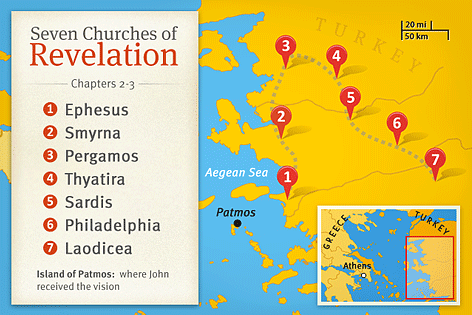
Yes. All of the 7 churches in Revelation still exist and are located in the west of Modern Turkey. Check the map of the question above.
Patmos Island, which is a Greek Island today, has a total area of 34 sq km and a coastline of about 60 km.
Inscriptions from the first two centuries AD describe Ephesus as the capital of Asia, “the first and greatest metropolis”. Located in Western Asia Minor (modern Turkey) on the Mediterranean, Ephesus was an important port linking trade between North Africa, Asia Minor, and Europe.
St. Paul lived in Ephesus from about 52-55 C.E. while writing the letters collected in the New Testament.
Walk in the Footsteps of St. Paul & St. John ✝️
Reading about the Church of Mary is one thing; standing exactly where the Third Ecumenical Council declared Mary as “Theotokos” in 431 AD is a deeply moving experience. Join my Biblical Ephesus Tours to discover the Christian heritage of Ephesus.


